
Many people considering breast augmentation naturally wonder, what does a boob job feel like both immediately after surgery and in the long run. The truth is, the way breasts feel after a boob job can vary from person to person and depends on several key factors, including the type of procedure, implant material, placement, and individual healing response. Some women describe early sensations such as tightness, pressure, or soreness during recovery, while others notice gradual softening as swelling subsides. Understanding how natural breast tissue feels compared to implant-based augmentation or fat-transfer procedures helps set realistic expectations and reduces anxiety before surgery.
What Does a Boob Job Feel Like? Nipple Sensation Changes After Breast Augmentation
Patient-reported outcomes often address sensory changes in the nipple-areolar complex (NAC) after breast augmentation, which is a key concern for those asking what does a boob job feel like over time. Some patients report temporary or long-term changes in nipple sensation following surgery, including reduced tactile or erogenous sensitivity. These sensory shifts can influence overall comfort and long-term satisfaction with the results. Clinical studies indicate that implant-based breast reconstruction may have a greater impact on postoperative breast sensation compared to how the natural breast felt prior to surgery.
For patients undergoing implant-based breast augmentation, the feel of the breasts is primarily influenced by the implant itself and the overlying tissue. Implants are placed either subglandularly (above the muscle) or subpectorally (under the pectoral muscle). The subfascial plane, which places the implant under the fascia but above the muscle, is also an option. The amount of natural breast tissue and skin coverage over the implant can affect palpability and how “natural” the breast feels. If there is inadequate soft tissue cover, the implant can be palpable or visible, potentially affecting the feel and aesthetic outcome.
Newer implant technologies and surgical techniques aim to improve outcomes and influence how breasts feel, which is a key consideration for anyone wondering what does a boob job feel like. Lightweight implants have been studied for their potential to reduce postoperative pain and accelerate recovery, indirectly contributing to a more comfortable long-term feel by minimizing mechanical strain. The cohesivity, viscosity, and surface characteristics of silicone gel implants—such as smooth versus textured—have evolved to reduce complications like capsular contracture and implant migration, both of which can affect the tactile sensation of the breast. Capsular contracture, where scar tissue tightens around the implant, may make the breast feel firm or hard, highlighting the importance of choosing the right implant type and surgical technique for optimal sensory outcomes.
What Does a Boob Job Feel Like After Reconstruction? Restoring Sensation with DIEP Flaps
The restoration of sensation after mastectomy and breast reconstruction plays a major role in overall patient satisfaction, especially for those researching what does a boob job feel like after reconstructive procedures. In autologous reconstructions such as DIEP flap surgery, surgeons may attempt to re-innervate the reconstructed breast by reconnecting sensory nerves to help restore feeling. For example, a randomized controlled trial comparing innervated versus non-innervated DIEP flaps highlighted the effectiveness of sensory nerve coaptation in improving postoperative sensation. Visual comparisons from these studies show that innervated DIEP flaps can regain areas of normal sensation, reduced light touch, or diminished protective sensation, while non-innervated flaps often experience significant loss of protective sensation across larger areas of the breast.
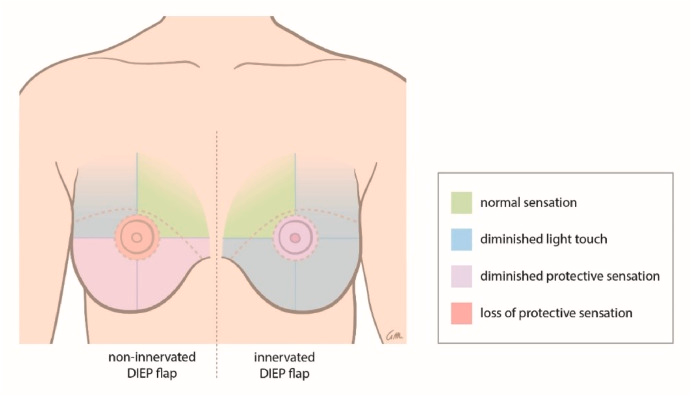
What Does a Boob Job Feel Like? Comparing Breast Sensation After Implant vs DIEP Flap Reconstruction
Research shows that breast sensation and overall quality of life can vary notably depending on the type of reconstruction, which is an important consideration for those wondering what does a boob job feel like after surgery. Studies comparing implant-based breast reconstruction with DIEP flap reconstruction have found that implants may negatively affect breast sensation. However, evidence also suggests that having an implant-based reconstruction first does not necessarily prevent sensory restoration if a DIEP flap is performed later. Tactile sensation is commonly evaluated using Semmes–Weinstein monofilaments (SWM) to measure sensory recovery, while emerging research is beginning to assess thermal sensation an understudied yet important factor influencing comfort, natural feel, and long-term satisfaction.
Related: How much does a boob job cost?
What Does a Boob Job Feel Like? Managing Postoperative Pain After Breast Augmentation
Postoperative pain is a major concern for patients undergoing breast augmentation and can affect the recovery experience. protocols and specific analgesic techniques, such as intercostal nerve blocks or pectoral nerve (PECS) blocks, are used to manage pain and accelerate recovery. Effective pain control contributes to a more comfortable early postoperative period and can influence overall patient satisfaction with the procedure.
In summary, the feel of a breast after augmentation is a complex interplay of the implant material, its placement, the patient’s existing tissue, and the surgical techniques used to preserve or restore sensation. While implants provide volume, the natural feel can be affected by factors like implant palpability and changes in nerve sensation. Autologous reconstructions offer potential for more natural sensation restoration due to nerve coaptation, but this is an area of ongoing research and development.